PPM Chapter 8 - Passenger Services and aircraft Ground Handling
8.2 – Passenger Classification
The following definitions relate to passengers:
- Infant: Under 2 years old
- Child: 2 to 12 years old inclusive
- Adolescent: Over 13 but younger than 16
- Adult: 16 years old or older
An unaccompanied minor is a passenger who is 5 to 11 years old inclusive, traveling without the supervision of a passenger aged 15 years or older. If the traveling parent is aged under 15 years old, the child is not considered an unaccompanied minor.
Standard Pax Weights
- Male: 91kg
- Female: 76kg
- Child: 49kg
- Infant: 16kg
Each child and adult includes a 7kg bag allowance
8.3 - Carriage of the Young
8.3.1 – Infants
Infants must not be carried in an emergency exit row. The number of infants permitted on each flight is limited by the number of infant seat belts carried.
Infants requiring the Child Aviation Restraint System (CARES) must not be seated in an emergency exit, in an aisle or middle seat, or in the last row of seats (due to limited access to install harness).
Infant pouches/slings are not approved as a restraint device.
8.3.3 – Children (Groups)
Groups of 15 children or less may be supervised by 1 adult over the age of 18. Groups of 16 children or more require 2 adults over the age of 18. Supervising adults must be suitable to sit in emergency exits.
8.3.4 – Unaccompanied Minors
Unaccompanied minors are generally passengers aged between 5 and 11 years old, however, at the parents request, a child aged between 12 and 14 may travel as an unaccompanied minor.
The maximum number of UMs onboard is 5. They can not be seated in emergency exit rows.
8.3 - Special Needs Pax
8.4.5 – DPL Pax
DPLs must not be used if the wind speed is in excess of 40kt or during lightning storms. This must be taken into account when planning a flight to a destination with marginal weather. The DPL must also not be used during refuelling (as the stairs must remain extended for a rapid disembarkation if required).
By law, we are not allowed to limit the number of wheelchair or handicapped passengers on a flight.
8.4.10 – Assistance Animals
The PIC may refuse carriage of an assistance animal if they believe it poses a risk to the safety of flight. In this case, the GMFO must be advised in writing.
The passenger and assistance animal must be seated in the same row. The animal is permitted to be seated in:
- 2B
- 5B
- 7B
- 8B
- 9B
- 10B
- 11B (B models) or 11C (where 11B is an aisle seat)
- 12B
Passengers may prefer to have the animal sit in the window seat or aisle seat, either are permittable.
8.4.12 – Disabled Pax
Individuals
Passengers who are not able to understand the safety briefing are required to travel with a carer. Where a passenger travels without a carer, but displays an inability to understand instructions or becomes disruptive due to their condition, an SMS must be submitted so the company can advise the normal carer that they are required next time. Ensure that the situation developed as a direct result of their condition and not other external factors.
Groups
The following ratios are required between disabled passengers and carers:
- 1 carer for every 3 disabled passengers (where at least one member requires assistance with eating, in the toilet, or who is unable to understand crew instructions), otherwise
- 1 carer for every 5 disabled passengers
The above ratio can be reduced if disabled passengers are more independent and can better look after their own welfare. This discussion will take place between the Call Centre and the group.
8.4.15 – Medical Conditions
The following passengers require a Fitness to Travel Medical Certificate with a valid date range and signed by an approved medical physician:
- Has an unstable medical condition
- Requires the use of oxygen
- Recovering from an acute illness or infectious disease
- Pregnant past the 36th week (not permitted to sit in emergency exit past 24th week)
- Has an intellectual disability or is unable to understand safety briefings
- Required to travel with a carer
Due to privacy concerns, crew must not query a passenger as to their illness. However, if a passenger volunteers information and the crew determine a possible risk to other occupants, more information may be queried. The PIC has the final say as to whether carriage is permitted.
Rex aircraft cannot accommodate stretchers onboard.
8.4.16 – Portable Oxygen
Passengers with portable oxygen concentrators must not be seated in an emergency exit row, or aisle seat which would impede the access of other passengers. The oxygen concentrator should be stored under the seat in front, with enough hose length to reach the passenger in their seat.
A Medical Certificate of Fitness to Fly is required to use an oxygen concentrator onboard. Otherwise, it may be carried but not used inflight.
Passengers are permitted to carry the following in the cabin:
- 2 BOC Gases Oxycare Travel Packs – hard case
- 1 BOC Gases Oxycare Travel Packs – soft case
- 2 Supagas Airline Travel Packs
- 1 Air Liquide Travel Pack
8.4.17 – Infectious Pax
Infectious passengers are not permitted to be carried onboard. Crew are not authorised to diagnose a person’s condition as infectious.
Crew should query a passenger and ask if they were recently ill, what their diagnosis was, and if they have a medical certificate of fitness to fly. If no clearance to fly was obtained and the crew has concerns about their infectivity, the captain may offload them. They will be advised that they can’t travel until they obtain medical clearance to do so.
The PPM lists diseases which require medical clearance before allowing travel.
8.6.2 – Dress Requirements
All passengers are required to wear at a minimum:
- Footwear (including thongs)
- Shirt
- Shorts/pants
8.7 – Passenger Documentation
An infant must have their own boarding pass, detailing their name and ‘/INF’ to indicate their infant status. All other information will be the same as the adult they are travelling with. When writing manual boarding passes, there is no requirement to issue a separate infant boarding pass, and the gate agent can instead record the infant details on the adult’s boarding pass.
On triangle sectors where the flight number remains the same, a single boarding pass will be issued. If the flight number changes on subsequent sectors, a separate boarding pass will be issued for each flight.
8.8 – Seating Summary
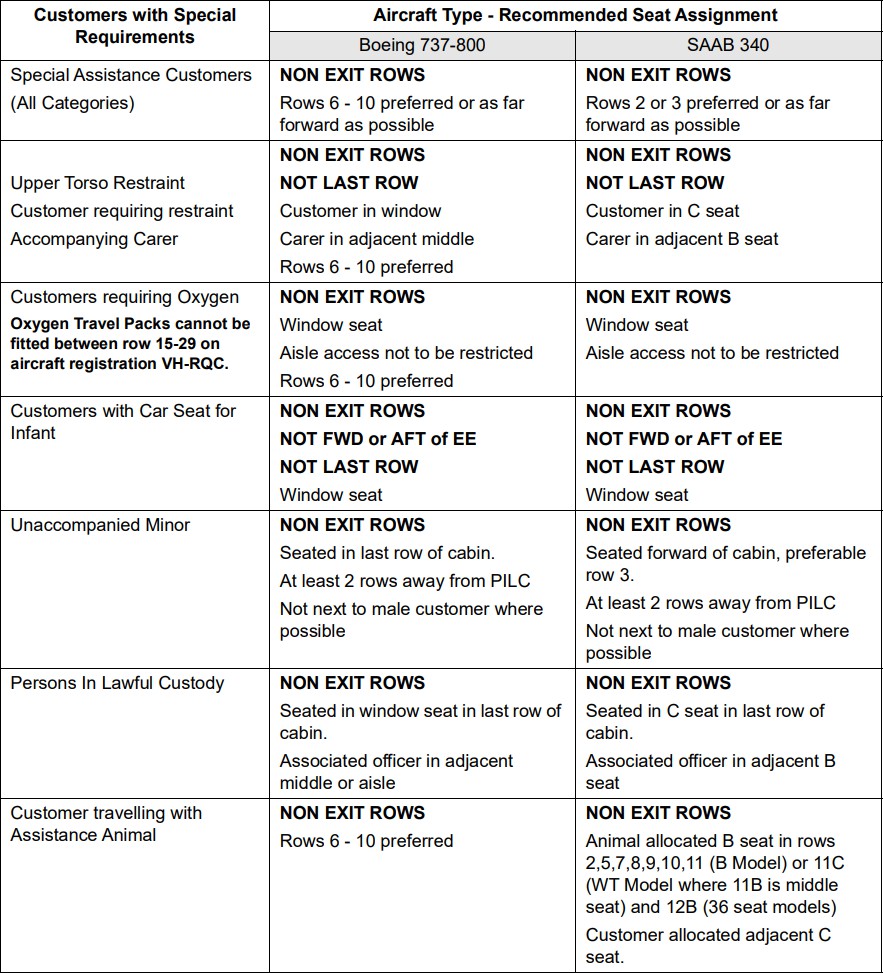
Passengers in exit rows must:
- Be willing & able to assist with the operation of the exit
- Be 15 years or older
- Be able to understand & acknowledge instructions from crew
- Not be travelling with someone who needs their assistance in an emergency (including a child, infant, special needs pax, etc)
- Not require supplemental restraints (including extension seatbelt)
- Not be more than 24 weeks pregnant
Non-English-speaking passengers may be seated in emergency exit rows where there are no suitable able-bodied English-speaking passengers. On charter flights with large numbers of non-English- speaking passengers, at least one English-speaking passenger must be seated in row 6 if there are non-English-speaking passengers in that row. There is no requirement for an English-speaking passenger in row 1.
8.8.4 – Two Children Sharing One Seat
Two children can share a seat provided:
- Aged between 2 and 11 years old
- Combined weight doesn’t exceed 77kg
- The children are from the same family and the family are advised Two boarding passes will be issued with the same seat number.
8.8.5 – Pax Travelling with Young
A person travelling with 2 infants must be allocated 2 seats, with one of the infants able to sit upright in the second seat by themselves.
Infant carry pouches must not be used as restraint devices. Some parents will argue their use, but they are not approved for use in motor vehicles and will degrade the safety offered by the infant seatbelt.
8.8.6 – Carriage in Excess of Max Number of Seats
The maximum number of infants permitted onboard is usually 5. However, more may be carried provided more infant seatbelts and life-jackets are obtained.
The maximum total number of passengers permitted onboard is 38 (or 35 for ZPB).
8.8.10 – Carriage of a Cello/Guitar
Large instruments can be carried in the cabin provided it does not exceed 20kg. Only one may be carried per row, and they must not be stowed in an emergency exit row or the row immediately in front of an exit row. The instrument must be carried in the window seat only.
The PPM details instructions to secure the instrument in the cabin.
8.9.1 – Responsibility for Boarding Passengers
On triangle sectors, a passenger may wish to disembark at a port different to their ticketed destination. Passengers without checked luggage may be permitted to do so. Ground staff will conduct necessary offloading procedures. Passengers with checked luggage are not permitted to disembark at an alternative port due to security concerns, unless it is a medical or family emergency that requires the passenger to be offloaded. In this case, their checked in luggage must be sourced and offloaded.
8.10.1 – Passenger Disembarkation
Where multiple special needs passengers are onboard, the disembarkation priority is as follows:
- Elderly, blind or deaf
- Disabled passengers
- Medical passengers (including those in wheelchairs)
- Ums
- Persons in lawful custody
8.11.4 – Passengers on Incorrect Aircraft
If a passenger is detected on the incorrect aircraft while airborne, the captain must notify the company and advise their name, original flight number and original destination. The company will decide whether to divert the flight or allow them to continue. An SMS is required from both the captain and flight attendant.
8.11.5 – Tarmac Transfers
Tarmac transfers from one Rex aircraft to another are permitted under exceptional circumstances, but only if the passenger has arrived from a screened port.
8.11.10 – Deaths Occurring on an Aircraft
The captain must radio ahead to advise the receiving ground agents and organise a doctor to certify death as required. Rex staff may assist authorities by providing details like name, address and contact details.
A body onboard must remain in its current place until released by the Coronial Authority (usually the local police). Where possible, it should be covered by a blanket.
8.13.9 – Freight
All freight carried onboard must be manifested. If freight must be offloaded and a single manifest does not break down individual weights for different items, the entire manifest must be offloaded unless the items can be individually weighed.
Live animals can be carried as freight provided a NOTOC is provided.
Dangerous goods must be accompanied by a NOTOC. It is good practice to get the FO to ensure that the DGs are stored safely in the cargo hold.
8.13.11 – Items Permitted in the Cabin
The following items are permitted:
- Umbrellas with metal points
- Knitting needles
- Pointed metal nail files
- Cork screws
- Sporting racquets
- Metal knifes with round points
8.14.1 – Standard Marshalling Signals
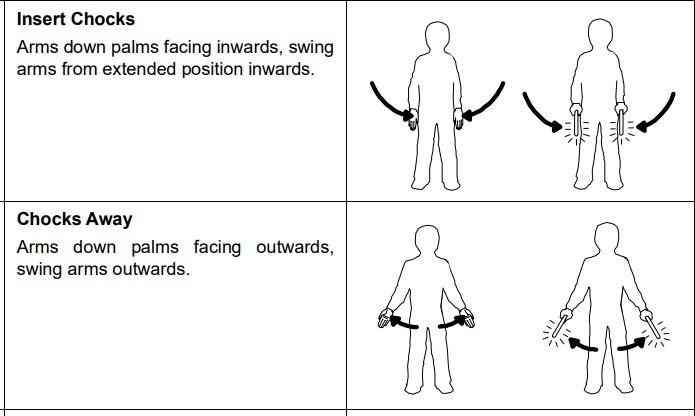
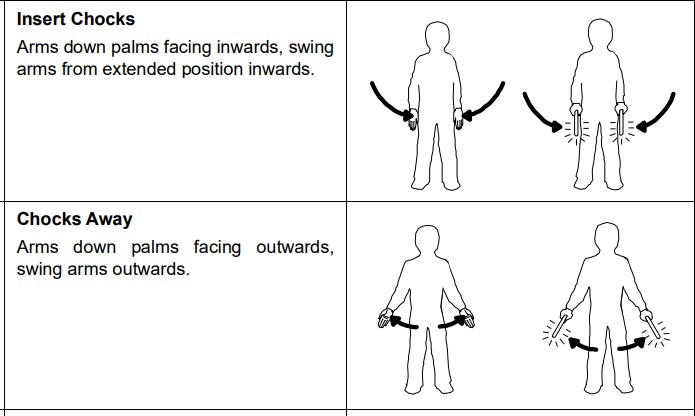
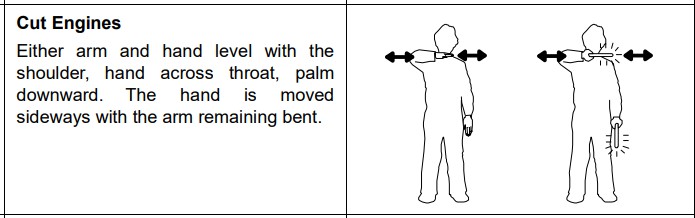
Additional signals include:
- Fire: an outstretched arm moving up and down in a fan movement, with the other hand pointing to the source of smoke
- Disconnect ground power: One vertical and one horizontal open palm, creating a T shape, with the vertical hand moved downward